Friday, 27 November 2009

Subtlemob 16th December


Subtlemob is happening again, 6.30pm in London on 16th December, in Birmingham on the 18th and Bristol on the 19th. Definitely worth checking out: http://www.subtlemob.com/

Thursday, 26 November 2009

Imaginative Engagement


I gave a talk and ran a workshop for architecture and creative writing students at the University of East London this week. We had some really interesting conversations about how writing can help us to understand and unpick place, and how writers and architects might work fruitfully together.
Helena Blakemore, who runs the creative writing course there, brought my attention to a really interesting project at Sheffield University, which has explored how creative writing can work to re-engage people with place, in this case the River Dearne in South Yorkshire. Worth a look: http://www.shef.ac.uk/landscape/staff/profiles/paulselman/research.html

Thursday, 19 November 2009

Poetry, Rain and Tokenism

I've been back from the internetless world of Hawthornden Castle almost two weeks now. It's been a bit of a whirlwind! Here are a couple of interesting things I've done/come across since I've got back:

A mass poetry writing project by Alan Summers, creating a 1000 verse renga, a really interesting Japanese form of communal poetry writing. You can find out more and get involved at: http://area17.blogspot.com/

Last week, I took part in Duncan Speakman’s Subtlemob in Covent Garden (a lovely take on the idea of flashmobbing). Participants loaded one of 2 sound files before the event, positioned themselves in a specified area of Covent Garden with a partner and then listened and followed instructions. It was pouring with rain. My partner was suffering from a cold and I felt bad dragging her through dark wet streets! I liked it though. Liked rather than loved. People were asked to do things (put a hand on their partner’s shoulder, look in a window etc.) and the story was orchestrated so that people were doing actions that were being described to you through your headphones. Some of it worked – I loved it when people were looking up at the tops of buildings, and when we were asked to dance. But there was an uncomfortableness there too. I felt we were asked to hold positions for maybe too long – though I can see it was needed for the thing to work. I was struck by the pacing and how music/soundtracks can influence our experience of a place. I found some of the content bordering on cheesiness, but I loved how it made you stop and look at the city in a way you hardly ever do.

On Monday I went to 'Architecture in an Age of Anxiety', a talk by John Sorrell (about to step down as chair of CABE) at the Tate Modern. He was talking about the state of architecture and the threats posed to high quality places by the recession. He issued a ‘clarion call’ to architects, to stand up and be counted, to turn down compromised jobs, to fight for high quality projects. Unrealistic, maybe, but it was interesting to listen to thoughts about how architecture needs to change and how the recession offers opportunities for reassessment and questioning. He talked about ‘informing and inspiring’ people so they can make informed and inspired decisions about their environment. I asked him to talk more about this – how do we enable people to talk with understanding and passion about the places they live in, how do we empower people to get involved? His answer was not inspiring to me! He talked about working with local people as clients, taking them to inspiring places, educating them about architecture. Fine, but he said ‘we need to find a group of people who represent the whole of the community’ – is that possible? I’m not pretending I have an answer, but I’m not convinced that this addresses the issue that lots of people don’t feel informed, inspired or motivated to fight for better places; finding a group of 5 people with the time to get involved, even if that group is truly diverse, isn’t going to solve this wider issue.

Friday, 9 October 2009

Off to the hills....

I'm off to Hawthornden Castle for a 4 week writing retreat. A world without internet and probably without phone reception.... so no blogging, no emailing, no distractions, just me and my novel - I can't wait! I'm back on 9th November.

Check out Global Poetry System, the brain child of Lemn Sissay, writer-in-residence at the South Bank Centre, co-ordinated by the fabulous Participation Manager, Lucy McNab. The site, which encourages people to photograph and upload the poetry they find in their environment - engraved in marble, scratched onto trees, written on toilet walls in permanent marker - was launched yesterday, on National Poetry Day. There are some real gems - have an explore and add your own discoveries.

Friday, 2 October 2009

Barking Arboretum


I went to the opening of Barking Arboretum on Wednesday. Having spent so long looking at plans and thinking about the potential of this space, it was great to see it finally open and being used. I love the way muf have made the space so magical: the railings turn into trees, seats are hidden away in corners, there's a stage just asking to be performed on.

There was also an exhibition of the work the RCA students did as part of Barking Metamorphosis. It was great to see how their work has developed since I last saw it. Some pieces have been made into permanent chairs and flooring in the arboretum. Will brought along a table-tennis table made from the Olympic blue fence, which was immediately put into use by passers-by.

My only disappointment was that there were no library staff or residents at the opening. I really hope people make this space their own - and I think there's real scope for the library to spill out into the arboretum...

Tuesday, 29 September 2009

Books as physical locations

I’ve been reading Art and Architecture: A Place Between, by Jane Rendell, who’s a really interesting professor, based at the Barlett (Faculty of the Built Environment, UCL). She comes from an architecture/public art/ art writing background, and is interested in writing’s relationship to art, place and architecture.
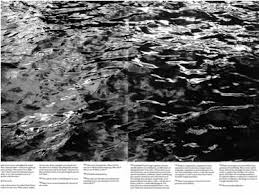

One of the many art pieces Rendell discusses is Roni Horn’s ‘Another Water’. The final piece is a book of images of the surface of water, interspersed with technical accounts of deaths on the Thames, and footnotes which are descriptions in the 1st person by Horn. The project was part of a series of commissions for the River Thames. Talking about it, Rendell says:

“Like the Internet, books are public sites accessible to diverse audiences, but not usually regarded as ‘physical’ locations. However, it is important to recognise that these kinds of sites have specific formal limits and material qualities, for example the size and layout of words on a page, and that ‘surfing the net’ as well as reading a book. Horn’s work points towards how different texts, from the empirical account constructed through careful and systematic research to the more poetic reverie, can, by drawing attention to the spatial ways in which we read images and words, main texts and footnotes, produce critical spaces through the act of reading, asking us to question the relation of fact to fiction in the writing of a cultural history of a place.”
I haven’t quite processed this yet, but I’m really interested in the connection between text and space, and the idea of reading as a spatial activity.

Wednesday, 23 September 2009

Midweek

You can listen again (or download the podcast) of my Radio 4 debut on Midweek this morning: http://www.bbc.co.uk/programmes/b00mr5n8.
And don't forget all those lovely stories (also downloadable as mp3s) at www.tfl.gov.uk/art